
Why UAE Developers Lose Margin Before Construction Starts
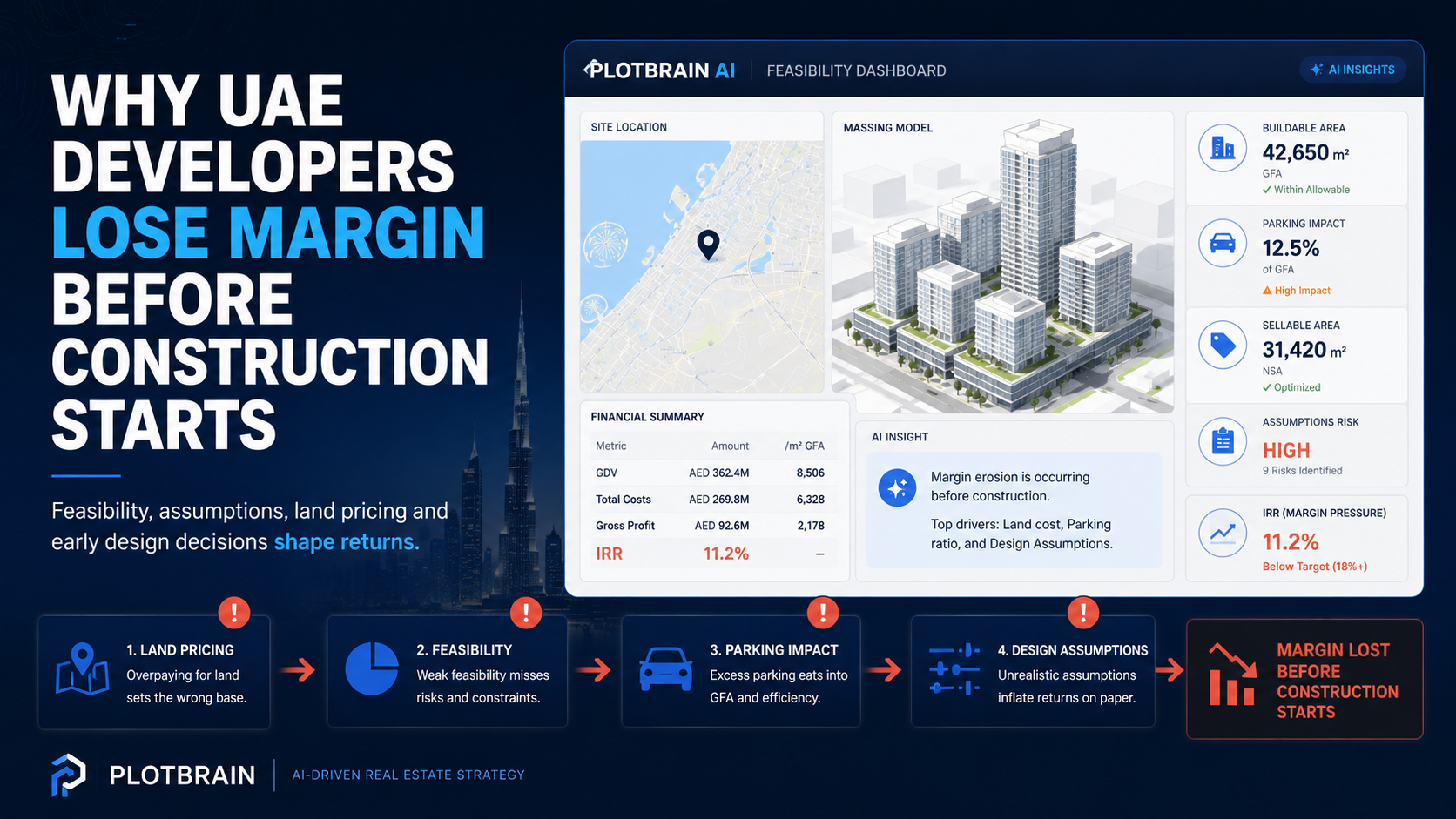
Why UAE Developers Lose Margin Before Construction Starts
Most developers believe margin is lost during construction.
Through cost overruns.
Delays.
Procurement issues.
Contractor claims.
Those risks are real.
But in many UAE development projects, margin is already lost before construction even begins.
It happens during the earliest stage of the project: land evaluation, feasibility, pricing, and concept design.
By the time a project reaches construction, many of the biggest financial outcomes have already been locked in.
Margin Loss Starts With Assumptions
Early feasibility is often built on assumptions that feel reasonable at the time:
- Expected height
- Estimated GFA
- Target sellable area
- Parking requirements
- Construction cost per square metre
- Sales price assumptions
- Approval timelines
Individually, each assumption may appear manageable.
But when several small errors combine, the project economics can change dramatically.
A project does not need one major mistake to lose margin.
It only needs a series of optimistic assumptions.
The Land Price Is Usually Set Before the Full Risk Is Known
One of the most common problems in UAE development is that land price is negotiated before feasibility is fully tested.
A plot may look attractive because of:
- Location
- Plot size
- Nearby developments
- Broker assumptions
- Expected height
- Market momentum
But if buildable area, parking, setbacks, or approval constraints are misunderstood, the land price may already be too high.
Once the price is agreed, the project team is forced to make the design fit the acquisition logic.
That is where margin pressure begins.
The Biggest Early Feasibility Mistakes
Several issues repeatedly reduce development margins before construction starts.
1. Overestimating Buildable Area
Developers may assume a higher GFA or BUA than is realistically achievable.
This can happen because of:
- Incorrect FAR assumptions
- Wrong height expectations
- Misread setback rules
- Ignored road width impact
- Master developer restrictions
When buildable area reduces, revenue reduces immediately.
2. Underestimating Parking Impact
Parking is often treated as a technical detail.
It is not.
Parking can affect:
- Basement requirements
- Podium design
- Structural cost
- Efficiency ratio
- Sellable area
One additional basement level can materially change development returns.
3. Confusing GFA, BUA, and Sellable Area
A project may look profitable when reviewed at GFA level.
But profitability depends on sellable area.
If the conversion from GFA to sellable area is too optimistic, the revenue model becomes inflated.
This is one of the most common sources of early-stage margin loss.
4. Applying One Emirate’s Rules to Another
The UAE is not one planning system.
Dubai, Abu Dhabi, Sharjah, Ajman, Ras Al Khaimah, Umm Al Quwain, and Fujairah all apply different planning logic.
A feasibility assumption that works in Dubai may not work in Sharjah.
A height assumption that works in Abu Dhabi may not apply in Ajman.
A coastal plot in Fujairah or RAK may have constraints that are missed entirely.
Multi-emirate development requires multi-emirate feasibility logic.
Why Late Corrections Are Expensive
When feasibility errors are discovered late, the project has fewer options.
The developer may need to:
- Redesign the building
- Reduce unit count
- Add parking levels
- Change the product mix
- Renegotiate consultant scope
- Accept lower IRR
Late corrections do not just cost time.
They reduce flexibility.
The earlier the mistake is identified, the cheaper it is to fix.
The New Discipline: Feasibility Before Commitment
The smartest developers are changing the sequence.
Instead of:
Land price → Concept design → Feasibility correction
They move toward:
Feasibility first → Scenario testing → Risk-adjusted land pricing
This creates better decisions.
Developers can:
- Price land more accurately
- Reject weak opportunities earlier
- Test alternative uses faster
- Protect margin before capital is committed
- Negotiate with more confidence
Feasibility should not be a confirmation exercise.
It should be a decision tool.
How PlotBrain Fits Into This
PlotBrain is built around one core belief:
The earlier feasibility becomes accurate, the more value it creates.
PlotBrain helps developers evaluate:
- Buildable area
- Setbacks
- Height potential
- Parking impact
- Massing efficiency
- Highest and best use
- Financial feasibility
The goal is simple: reduce assumption risk before major decisions are made.
Because in development, the best time to protect margin is before the project starts.
Conclusion
Construction risk matters.
But many UAE projects lose margin long before a contractor arrives on site.
They lose it through weak assumptions, incomplete feasibility, overpaid land, and late-stage corrections.
The next generation of developers will not only manage construction better.
They will make better decisions before construction begins.
That is where margin is protected.
Follow PlotBrain for weekly insights on UAE feasibility, planning logic, and AI-driven development strategy.