
Why Parking Ratios Quietly Destroy IRR
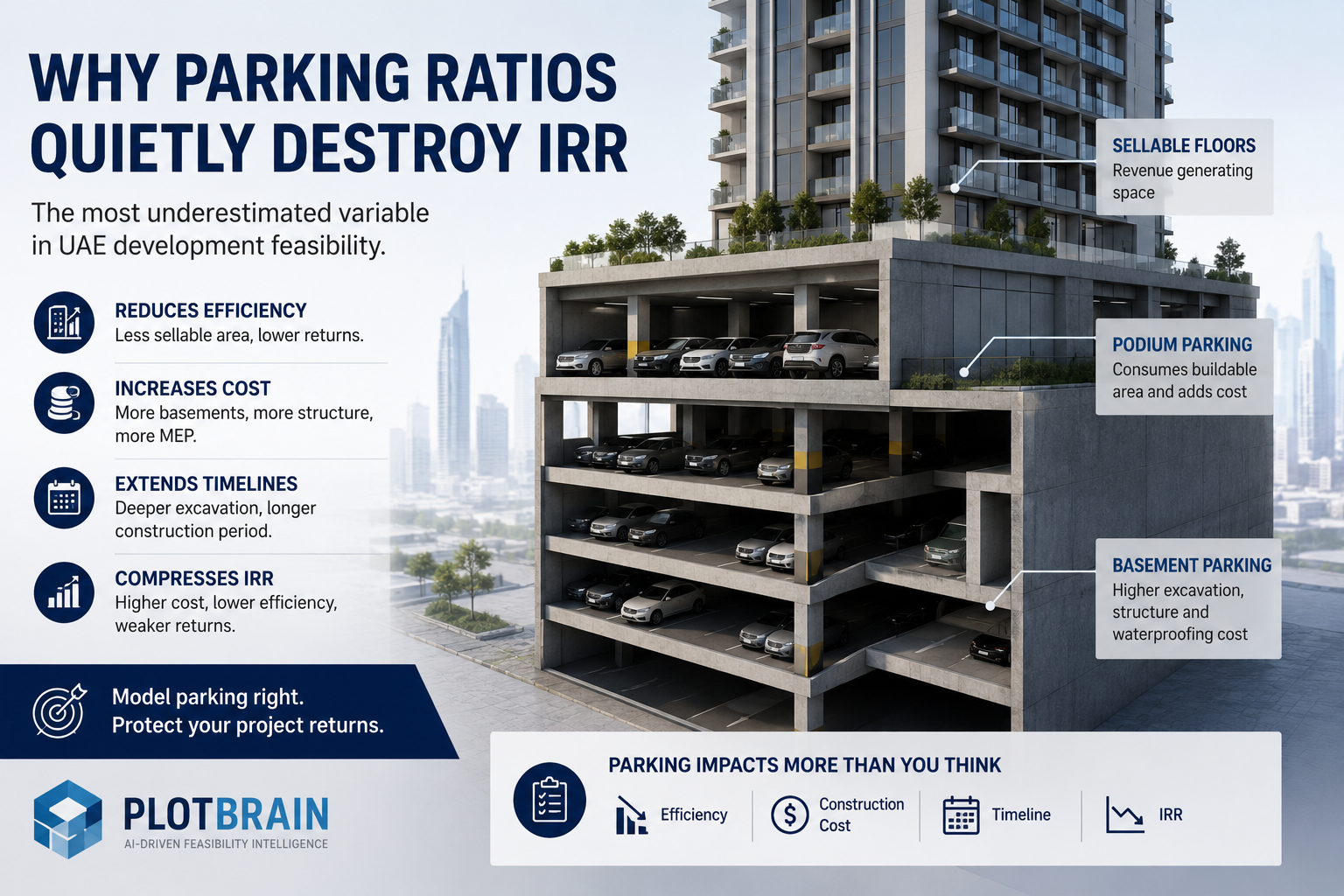
Why Parking Ratios Quietly Destroy IRR
When developers discuss feasibility, the conversation usually focuses on:
- Land price
- Sales value
- Construction cost
- Height potential
But one variable quietly reshapes the entire project:
Parking.
Parking is not just a compliance requirement.
It directly affects:
- Efficiency ratios
- Structural complexity
- Basement cost
- Sellable area
- Development timelines
- Ultimately, IRR
Across the UAE, parking is one of the most underestimated feasibility variables.
Why Parking Impacts Feasibility More Than Most Realise
Parking consumes some of the most expensive parts of a building.
Depending on the project type, parking may require:
- Additional basement levels
- Larger podium structures
- Increased ramp space
- Greater structural spans
- More MEP coordination
All of this increases cost while producing no direct revenue.
Unlike residential or retail space, parking does not generate sales value proportional to its footprint.
The Efficiency Problem
Parking reduces efficiency in two ways:
1️⃣ It consumes buildable area
Space allocated to parking cannot be sold as apartments, offices, or retail.
2️⃣ It reshapes building geometry
Parking layouts often force:
- Larger cores
- Deeper floor plates
- Structural compromises
- Reduced flexibility in unit mix
The result is lower net sellable efficiency.
How Parking Ratios Differ Across the UAE
Parking logic varies significantly by emirate and project type.
Dubai
- More flexibility in some zones
- Shared parking occasionally permitted
- Mixed-use projects may optimise ratios
Abu Dhabi
- Stricter enforcement
- Higher parking allocation in some districts
Sharjah & Ajman
- Parking can materially reduce FAR utilisation
- On-site parking often mandatory
RAK & Northern Emirates
- Moderate ratios, but tourism projects may differ
Applying Dubai assumptions outside Dubai is a common feasibility mistake.
The Hidden Cost of Extra Basement Levels
An additional basement level may:
- Add significant excavation cost
- Extend programme duration
- Increase waterproofing complexity
- Raise financing exposure
Yet many early-stage feasibility models underestimate this impact.
A project may appear profitable — until parking requirements force another basement.
That single change can materially compress IRR.
Why Parking Errors Compound Quickly
Parking mistakes affect multiple layers simultaneously:
- Lower sellable area
- Higher construction cost
- Reduced efficiency
- Longer build time
- Increased financing cost
Individually manageable.
Collectively destructive.
This is why disciplined developers model parking early — before land pricing decisions are finalised.
How PlotBrain Handles Parking Automatically
PlotBrain integrates:
- Emirate-specific parking ratios
- Use-based parking logic
- Massing impact analysis
- Basement and podium implications
- Efficiency calculations
Instead of approximating parking impact, developers receive feasibility outputs with parking already embedded into the analysis.
Conclusion
Parking rarely appears in land marketing brochures.
But it quietly shapes the economics of nearly every UAE development project.
Developers who underestimate parking risk:
- Overpay for land
- Overestimate efficiency
- Underestimate cost
The smartest developers model parking before they model profit.
Follow PlotBrain for weekly insights on UAE feasibility, planning logic, and AI-driven development analysis.