
The UAE’s Next Real Estate Advantage Will Be Feasibility Speed
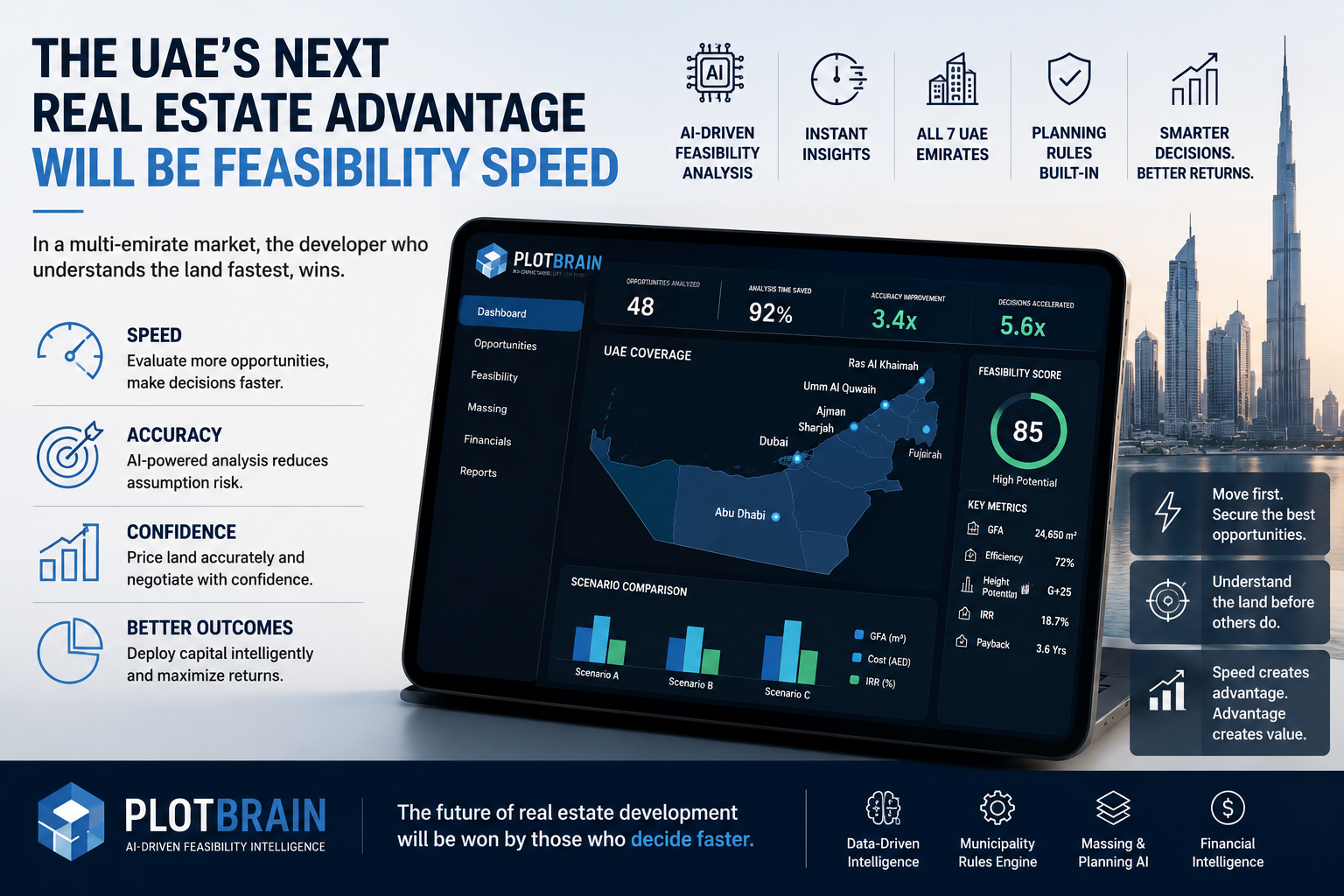
The UAE’s Next Real Estate Advantage Will Be Feasibility Speed
For years, real estate advantage in the UAE was built around access.
Access to land.
Access to capital.
Access to approvals.
Access to relationships.
Those factors still matter.
But the next advantage will come from something different:
Feasibility speed.
In a market moving across Dubai, Abu Dhabi, Sharjah, Ras Al Khaimah, Ajman and the Northern Emirates, developers who can evaluate land faster — and more accurately — will outperform those who rely on slower, fragmented analysis.
The Market Is Moving Faster Than Traditional Feasibility
UAE real estate is no longer limited to a single dominant development market.
Capital is now moving across multiple emirates. Developers are comparing opportunities in Dubai against RAK, Sharjah against Ajman, Abu Dhabi against emerging coastal destinations.
But the feasibility process has not kept pace.
Traditional early-stage feasibility still depends on:
- Manual planning interpretation
- Consultant availability
- Spreadsheet modelling
- Back-and-forth design revisions
- Assumption-heavy land pricing
That process is too slow for a market where good opportunities disappear quickly.
Speed Without Accuracy Is Dangerous
Fast decisions alone are not enough.
A developer can move quickly and still make the wrong decision if feasibility assumptions are flawed.
The real advantage is not speed on its own.
It is fast, reliable interpretation of:
- Planning rules
- Buildable area
- Parking impact
- Height potential
- Massing efficiency
- Financial feasibility
That combination is what changes decision-making.
Why Multi-Emirate Development Increases the Need for Speed
When a developer operates in one emirate, experience can compensate for inefficiency.
The team knows the planning logic.
The consultants know the municipality.
The assumptions are familiar.
But across multiple emirates, this breaks down.
Each market has different:
- Setback logic
- Parking expectations
- Height controls
- GFA definitions
- Master developer overlays
- Approval risks
Without a faster feasibility engine, multi-emirate expansion becomes slow, inconsistent and consultant-dependent.
The New Competitive Question
The old question was:
Who has access to the best land?
The new question is:
Who can understand the land fastest?
Because the developer who understands feasibility first can:
- Negotiate with more confidence
- Reject weak opportunities earlier
- Price land more accurately
- Test alternative uses faster
- Deploy capital more intelligently
In a competitive market, speed compounds.
AI Will Shift Feasibility From Service to Infrastructure
Feasibility has traditionally been treated as a service.
A developer sends a plot to a consultant.
The consultant studies it.
A report comes back days or weeks later.
That model will not disappear, but it will change.
AI will turn early-stage feasibility into infrastructure — always available, instantly repeatable, and scalable across locations.
This does not replace professional judgement.
It gives judgement a stronger starting point.
What This Means for UAE Developers
The next generation of developers will not win by simply hiring larger teams.
They will win by building better systems.
Systems that can:
- Analyse more plots
- Compare more scenarios
- Reduce assumption risk
- Standardise decision-making
- Move before competitors
Feasibility speed will become a boardroom advantage.
Conclusion
The UAE real estate market is becoming more dynamic, more multi-emirate and more competitive.
In that environment, slow feasibility becomes a hidden cost.
Developers who can assess land faster and more accurately will not just save time.
They will make better acquisition decisions.
The future of development advantage is not only access.
It is speed, accuracy and systemised feasibility.
Follow PlotBrain for weekly insights on UAE feasibility, planning logic and AI-driven development strategy.